

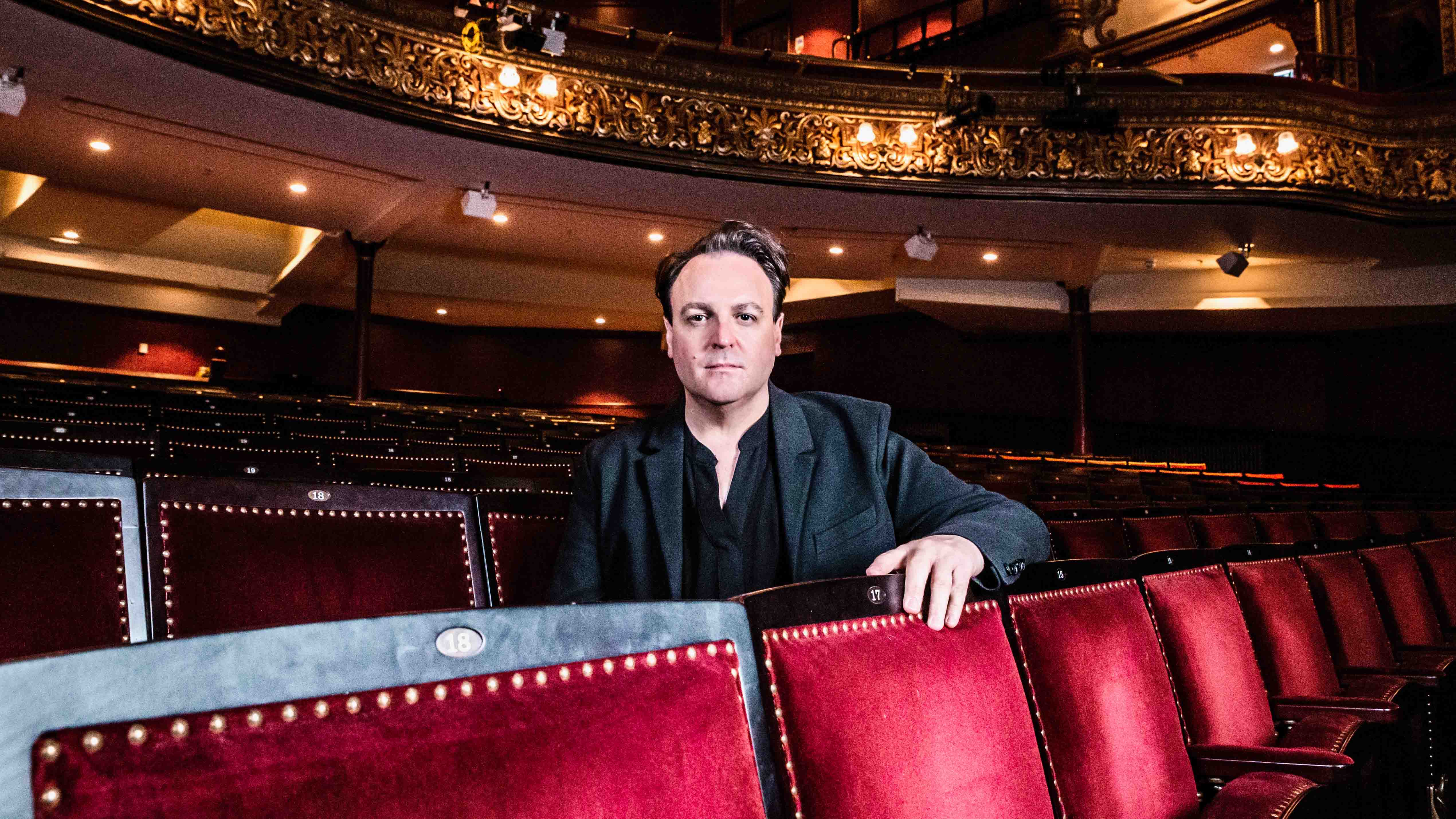
In conversation with Director Cameron Menzies
Cameron Menzies, Director of Eugene Onegin for West Australian Opera
The Stories That Change With Us
Why isn't Eugene Onegin performed as much as some other operas in Australia?
I'm always delighted when someone tells me they're coming to Eugene Onegin for the first time, because I think it's one of the great operatic discoveries. It may not be programmed as often in Australia as La Bohème, Carmen or Madama Butterfly, but it absolutely deserves to be.
Unlike some of the great Italian classics, Eugene Onegin isn't built around a string of famous tunes that everyone already knows. Instead, it's built around one of the most beautifully observed stories in the operatic repertoire.
Many people expect a grand Russian epic, but what they discover is something far more intimate—a deeply personal story about youth, missed opportunities, pride, love and regret. It's about people making decisions in a single moment that echo throughout the rest of their lives. That's something every one of us can recognise.
I also think Onegin rewards you every time you encounter it. It's one of those rare operas that quietly reveals more of itself with each performance. Every time I come back to it, I discover another layer in the score or another truth about the characters that I hadn't noticed before.
Tchaikovsky understood people so profoundly that, as you change through life, Eugene Onegin seems to change with you. I think that's the mark of a truly great work of art.
What would you say to opera lovers who aren't familiar with Eugene Onegin?
The first thing I'd say is: don't spend the evening trying to decide who's the hero and who's the villain.
That's one of the reasons I love this opera. Nobody is entirely right, nobody is entirely wrong, and everyone carries some responsibility for what unfolds. They're all wonderfully human. They make impulsive choices, they misunderstand each other, they allow pride to get in the way, and sometimes they realise what they've lost far too late.
There's also something remarkably modern about that. We often think opera is about kings, queens and mythology, but Onegin is really about emotional timing. It's about saying the wrong thing, not saying the right thing, or realising years later that you completely misunderstood someone.
One of the reasons audiences continue to connect so deeply with this piece is that every character is changed by the choices they make. Nobody leaves the opera as the person they were at the beginning, and I think that's a very truthful reflection of life.
And then there's Tchaikovsky's music. He has this extraordinary gift of allowing the orchestra to express everything the characters cannot bring themselves to say. Sometimes you'll hear the truth in the orchestra long before the characters themselves recognise it. It's incredibly cinematic in the way it draws you inside their emotional world.
Would Eugene Onegin be a good first opera experience?
I actually think Eugene Onegin is one of the best introductions to opera because it doesn't rely on spectacle alone. Everything begins with recognisable human emotions.
People often ask me, "Why are they singing?" I always say that opera begins where ordinary conversation runs out. We've all had moments when words don't quite seem enough—when we're overwhelmed with joy, heartbreak, excitement or regret. Opera simply gives those feelings music.
The wonderful thing about Onegin is that you don't need to know anything about Russian history or nineteenth-century literature to enjoy it. You simply follow the relationships between these people. If you've ever experienced first love, rejection, embarrassment, loss or wondered "what if?", then you're already halfway into the story.
I also think it's a wonderfully accessible opera because the characters never feel remote. They aren't mythical heroes or historical figures beyond our understanding. They're people trying to navigate love, friendship, pride and expectation—things we've all experienced in one form or another.
And don't worry about trying to understand every plot detail. Let yourself be carried by the music. Tchaikovsky is one of the great emotional composers, and he'll guide you exactly where you need to go. Also there are always the English surtitles is you want to follow exactly what is being said by each of the characters.
As a director, what is your take on the original story written by Alexander Pushkin, and Tchaikovsky's operatic version?
Pushkin occupies an extraordinary place in Russian literature. His writing has a remarkable balance of elegance, wit and psychological insight. He doesn't simply tell us what people do; he understands why they do it, and often why they make exactly the wrong choices.
What fascinates me is that his characters never feel like literary inventions. They feel astonishingly real. They contradict themselves, they hesitate, they overreact, they regret. In many ways they feel surprisingly contemporary, despite having been written nearly two centuries ago.
Then Tchaikovsky comes along and doesn't simply set the poem to music—he opens up everyone's emotional landscape. The music doesn't replace Pushkin's words; it deepens them.
I've often thought of Pushkin as writing the diary, while Tchaikovsky allows us to hear the heartbeat. Pushkin gives us the observations, the thoughts and the poetry. Tchaikovsky allows us to experience what those emotions actually feel like from the inside.
One of the things I admire most about Tchaikovsky is that he never judges his characters. He understands them. Even when they make painful or frustrating decisions, the music is full of compassion. As a director, that's a wonderful place to begin because it reminds you that our job isn't to judge these people—it's to understand them and help an audience understand them too.
It's one of those rare collaborations across time where literature and music seem destined for one another.
Your production has some beautiful costumes and striking lighting, video and set design. What are the production elements to watch out for?
I do love period productions, not because I'm interested in recreating a museum piece, but because period settings can often allow us to look more clearly at ourselves. We may have mobile phones and social media now, but human nature hasn't really changed all that much. We still fall in love, make impulsive decisions, say things we regret and spend years wondering what might have happened if we'd chosen differently.
For me, period is never about nostalgia. It's about creating a world where the audience can concentrate on the emotional truth of the story without the distractions of the everyday world we all live in.
Our design team have created a world that feels authentic to the period while allowing the emotional story to remain absolutely central.
Niall McKeever's set is deceptively simple. It constantly transforms, almost like memory itself, creating spaces that feel both real and imagined. There are moments when the stage becomes less about geography and more about the emotional landscape the characters are moving through.
The lighting and video design play an equally important role. They aren't there simply to look beautiful—although they certainly do—but to help us move between memory, reality and reflection. Sometimes the design quietly tells the audience something about a character's emotional state before they've even admitted it to themselves.
One of the great joys of opera is that every creative department is telling the same story. The orchestra, the singers, the instrumentalists, the costume designer, set designer, lighting designer, video designer, movement director and stage management team are all contributing to the same emotional journey.
I often say that audiences shouldn't notice the design as individual elements. They should simply feel immersed in the world we've created. If we've done our job well, everything is working together in service of the story.
So much work goes into a new production. What is it like to revisit a production years later?
It's actually one of my favourite parts of directing.
Creating a new production is incredibly exciting because you're discovering everything for the first time. Every rehearsal feels like an experiment. You're asking hundreds of questions every day and, little by little, the production begins to reveal itself.
Coming back to it years later feels completely different. It's a bit like opening an old photo album or returning to a place you haven't visited for years. You remember the journey of making it, but you're no longer the same person who created it.
The wonderful thing is that the production itself has stayed the same, but you haven't. You've had more experiences, directed more productions, learnt new things about people and about yourself. Inevitably you bring all of that back into the rehearsal room.
Different casts also transform the piece. Every Tatiana, every Onegin and every Lensky brings something unique. I never want performers to imitate previous interpretations. My job is to help them discover their own truth within the production, because that's what keeps theatre alive.
In many ways, returning to a production reminds me of what we were talking about earlier with Onegin itself. Great works of art don't really change—but we do. We arrive with different life experiences, different perspectives and different questions, and suddenly moments that never struck you before become deeply significant.
That's one of the real privileges of directing. You never stop discovering.
So a revival isn't about preserving something under glass. It's about allowing the production to breathe again with a completely new group of artists, while rediscovering the work yourself through fresh eyes.
You have been Artistic Director and Chief Executive of Northern Ireland Opera since 2020. What's it like directing outside Australia and what are your feelings about returning to direct back home in Australia?
It's genuinely very special.
I've now spent several years leading Northern Ireland Opera, and it's been an extraordinary chapter in my career. We've built ambitious productions, developed artists, expanded our community work and created some remarkable international collaborations. I'm incredibly proud of what we've achieved together.
Working internationally constantly reminds you that every company has its own personality. Every audience has different expectations, every rehearsal room has its own rhythm, and every country has its own relationship with opera. That's one of the great joys of this profession—you never stop learning.
Coming back to Australia always feels wonderfully familiar. This is where I learnt my craft, where I first fell in love with opera and where so many of my artistic friendships began.
One of the greatest pleasures of returning is the wonderful mix of people you find in the rehearsal room. There is something incredibly exciting about collaborating with Australian artists I've never worked with before. Every new artist brings a different perspective, a different energy and often makes you see the piece through fresh eyes. That's one of the real joys of directing—you never stop learning from the people around you.
At the same time, it's equally rewarding to reconnect with long-time artistic colleagues. Theatre is built on relationships and trust, and there's something very special about walking into a rehearsal room with people who understand your shorthand, your way of working and your sense of humour. Those relationships have often been built over decades and continue to evolve with every production.
One of those relationships is with West Australian Opera's Artistic Director, Chris van Tuinen. Chris and I first met as students at the Victorian College of the Arts, where we were both finding our feet—Chris as a conductor and me as a director. We grew into our careers alongside one another, each forging our own path while remaining connected through our shared love of opera. Now, many years later, we both have the privilege of leading our own opera companies.
There's something rather lovely about coming full circle in that way. We know each other well, we trust one another implicitly, and we've always shared the same belief that the work on the rehearsal room floor comes first. Once rehearsals begin, titles become largely irrelevant. It's simply about creating the very best piece of theatre we can, supporting the artists around us and telling the story as truthfully as possible. That shared artistic language and mutual trust is something I value enormously.
It's equally wonderful to reunite with treasured collaborators like Nicole Youl, with whom I've had the pleasure of working over many years. Working with someone like Nicole feels wonderfully instinctive. There's a shared creative language and an ease that only develops through years of making work together, but there's still the excitement of discovering something new every time you collaborate.
Australian rehearsal rooms also have a particular energy that I absolutely love. There's a directness, generosity and sense of humour that feels immediately like home. Somebody usually makes a joke before we've even sat down, and that's often the perfect way to begin making theatre.
Returning to direct for West Australian Opera feels a little like coming home. The faces may have changed, new artists have joined the family, careers have evolved and companies have grown, but the spirit of making opera together feels wonderfully familiar. That's a very special feeling.
More than anything, it's a privilege. This production means a great deal to me, and to be able to revisit it with Australian artists, old friends, new collaborators and the wonderful team at West Australian Opera is something I'm genuinely excited about.
Opera has given me a career that has taken me around the world, but it's always a joy to come home and tell stories with the people who first inspired me to believe in the power of this art form.
EUGENE ONEGIN runs from 6 - 15 August at His Majesty's Theatre. Book now!