WAO 2026 season is now on sale. Where every heart finds its song. Book now


Shine light on Violetta
West Australian Opera opens La traviata on Saturday 14 March.
Widely regarded as one of the most famous operas ever written, this award-winning production re-examines the work through a feminist lens under the direction of Sarah Giles. After touring nationally and returning to Perth following a sold-out season in 2022, audiences are once again invited to rediscover the true story of Violetta.
Sarah, what was your biggest influence on this production?
There are a few things. Whenever I looked at past productions of La traviata, I had a reaction against lots of those. I couldn’t believe what I was reading! It felt like every single time I wasn’t seeing the real Violetta, or I wasn’t reading the real story of her.
The opera is based on Dumas’ book Lady of the Camellias, which he based on the real-life experience of Dumas’ courtesan lover, Marie Duplessis. Then that book got turned into a play, Verdi and his librettist saw it, and turned it into an opera. Every single time we were watching the story from the perspective of these men, we never saw it from Violetta’s perspective. This drove me to do some research and I found this book by Celeste Mogador, a courtesan in a similar era to the woman that Marie Duplessis was based on.
How did you insert your take on it?
With this particular production, I always felt very clear that I wanted to see Violetta’s story from her perspective and understand more of her psychology. So, to put that on stage and invite the audience into my research and into my thinking, we created a space that could allow that. When set and costume designer Charles Davis and I first sat down, I wanted to be able to see into both the public and private worlds of her apartment. In the prelude, there are huge moments of music and no singing. This affords you the ability to increase the storytelling. That’s what is great about opera: There is so much room for more storytelling than just the words being sung!
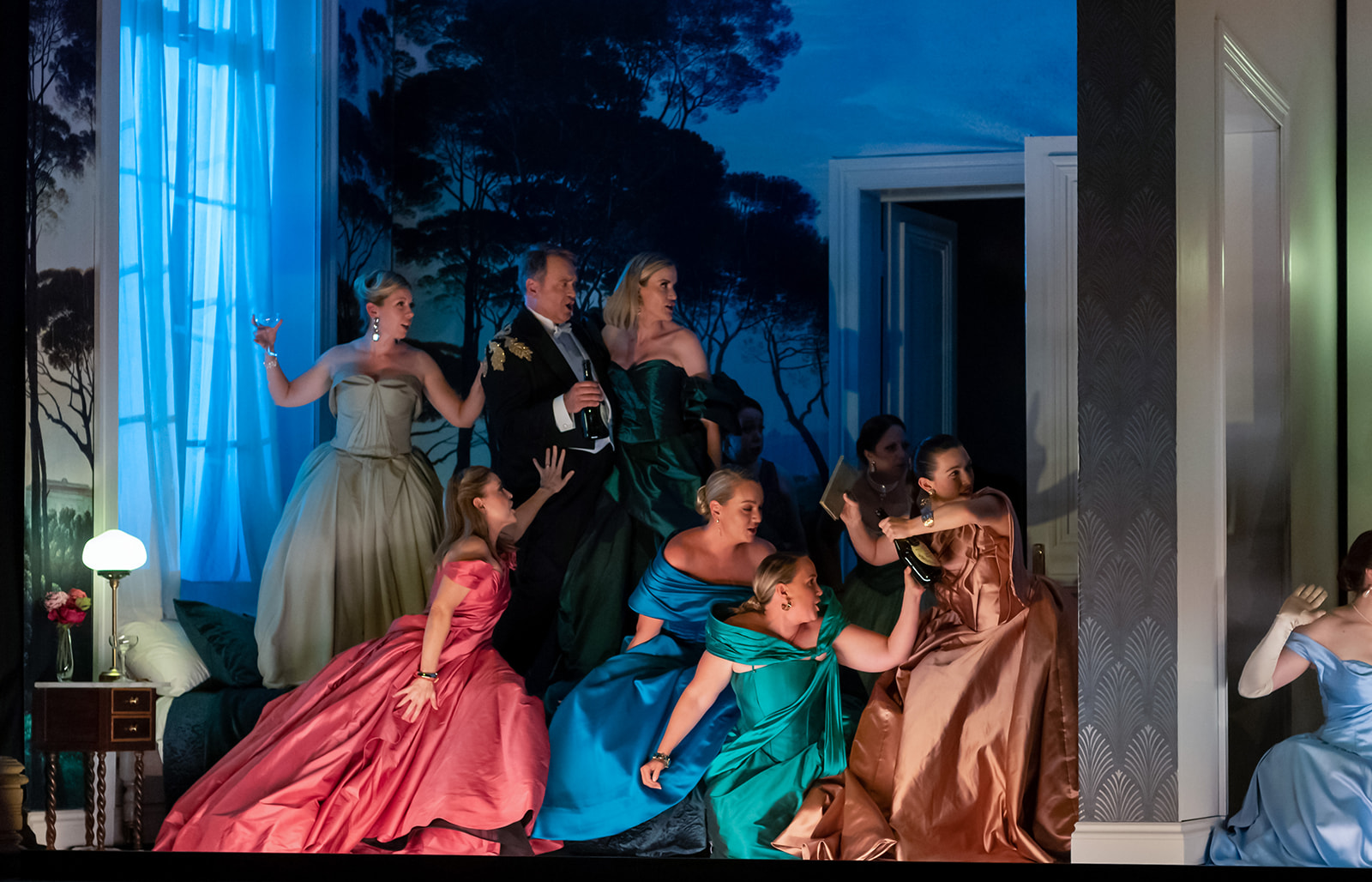
Knowing that La traviata has been produced countless times in contemporary settings, what made you put it back in the nineteenth century?
There is always the assumption that a contemporary production will have everyone in jeans, runners, and t-shirts. This is a misnomer. A contemporary production can be set in any era and still bring an incredibly contemporary political message to the work. More often than not, arbitrarily setting a piece like La traviata now actually diminishes the work. You can look at the politics of now through the prism of another era and I find that really useful.
La traviata is known for the party scenes, the glam, and the gowns. In the collective it’s not really known for the story of Violetta…
It’s mad! It’s bonkers that when everyone thinks of La traviata there is a lavish party scene, dresses, gypsies and matadors, a staircase... It’s all these tropes and assumptions that miss the point of the opera. If you can make Violetta real, if you can find the truth of that character, I think it speaks to an audience more. The word traditional is very dangerous in opera. Opera is not a historical artifact, it’s a living and breathing artform and for it to find new audiences, you need to find new people to tell the story. I think traditionally, not many female-identifying directors had the chance to work on this production.
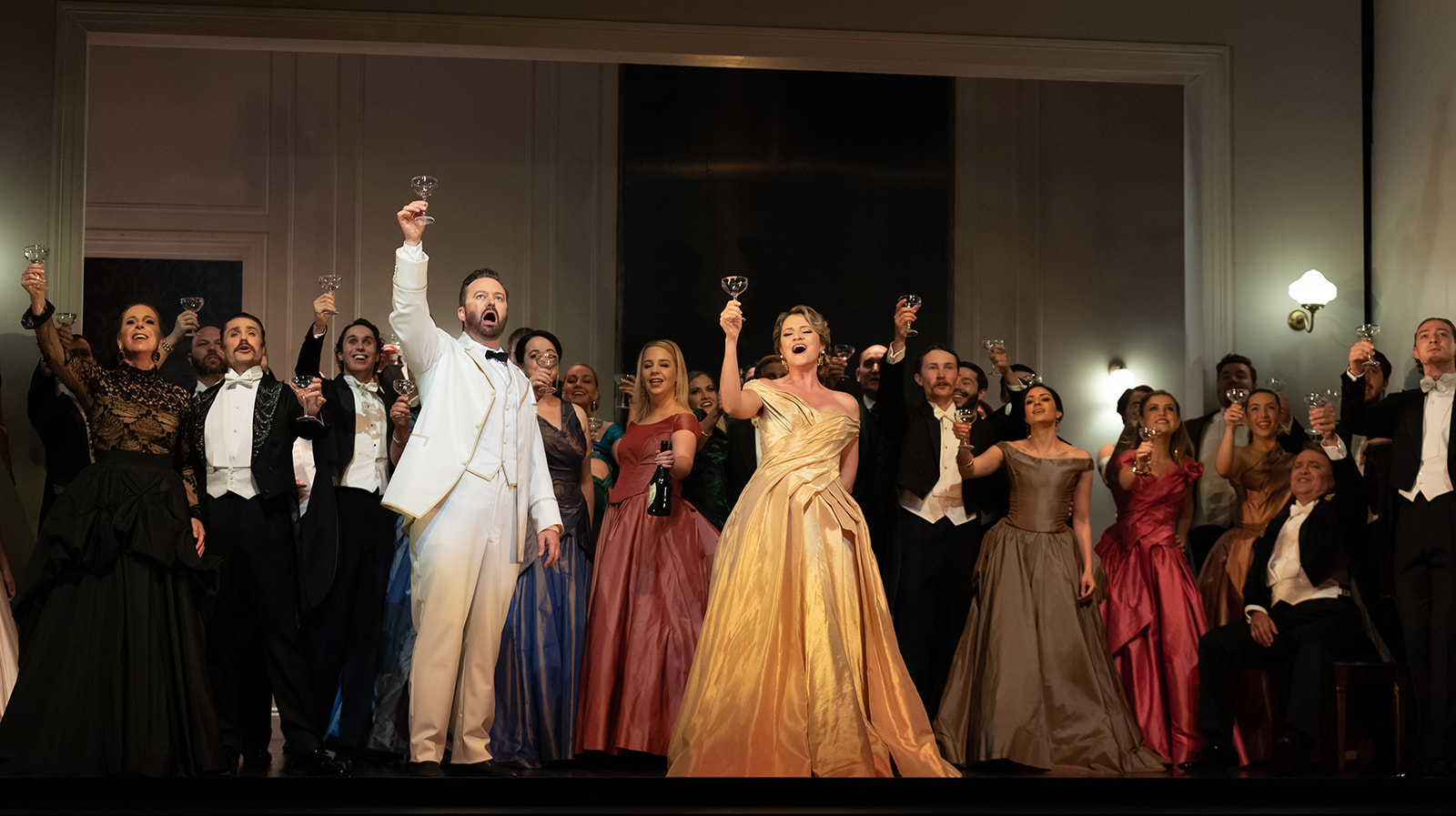
Why do you think this story is still relevant today, after more than 200 years?
The notion of female worthiness is really relevant. That some women are more worthy of happiness and love than others, that we still have women on a sliding scale according to how society judges them. I think one of the things that fascinates me about Violetta’s character is that she is internalising the misogyny of this world. She is a product of her own society. Her decision not to pursue her relationship with Alfredo, so Alfredo’s sister can marry someone, is one of the points in the opera where everyone tends to think that she’s such a good girl and a kind prostitute. Violetta thinks that somehow this young girl is more worthy of happiness than she is. This is unbelievably tragic! That’s one of the things about the character that I wrestled with: How to portray that not as a sweeping gesture of kindness and goodheartedness, but how to portray that gesture as self-hatred. It’s subliminal because she is not even aware that she’s doing it.
The other thing is the performative nature. I see this even with my daughter and in my childhood. Women are taught from a very young age to make other people comfortable before themselves. It really hit home with Grace Tame, when everyone was angry because she wouldn’t smile at the Minister. There is still a huge expectation on women to please men, put them first and make them feel comfortable. We have a long way to go on that front.

I think that intersectional feminism, where class and gender intersect, is an interesting place. Violetta is an example of that. She is someone who was not born into high society. She grew up in abject poverty, and she is a woman. At the age of 16, she decided that the best way forward was to sell her body. In France in this era, you could sign a form and go on the register to become a prostitute, and once you were on that register, you could never get off that. We talk a lot about feminism, about class, and racism, but we need to talk a lot about the intersectionality of those things. She sings that famous aria Sempre Libera (Always free… To have a good time). In my version, it is not that she is running around the house having a party, it’s more her mantra to say, “I’ve made a series of choices and what I have now is financial freedom. I am earning my own money; I have my own house. I am free. That’s as free as I can ever get because I am a prostitute, I have signed the register so I can never be anything else”. At the exact moment, the three women she is paying to serve her enter on stage.
West Australian Opera presents La traviata from Saturday 20 March at His Majesty’s Theatre. Book now.
Photography by Clinton Bradbury
This article was written in October 2022.